
Summary
Rethinking What We Measure in Early Reading: Reflections from NCSA 2026 on deaf and hard of hearing students, early literacy assessment, and designing measurement systems that better reflect how students learn.
At the National Conference on Student Assessment (NCSA) 2026, I focused on a question that has important implications for students, educators, and assessment developers alike: do our tests measure how deaf and hard of hearing students learn to read?
Together with Cara Laitusis and Tamara Copeland-Samaripa, we explored how deaf and hard of hearing students develop reading skills and what current research tells us about the strengths and limitations of today’s early literacy assessments.
Looking Beyond the Assessment
A key theme from the session was this: assessment is only as meaningful as the construct it is designed to measure.
- When important learning pathways are excluded, we measure less than we intend.
- When assessments assume a single route to success, they overlook learner variability.
- When evidence evolves but assessments do not, the gap between research and practice continues to grow.
These are not simply technical challenges. They influence how students are identified, supported, and understood.
During the presentation, I shared research that highlights this disconnect. One finding prompted an especially important conversation. A meta-analysis of more than 2,000 Deaf readers found that spoken phonological awareness accounted for approximately 11% of the variance in reading outcomes. In studies that also measured language ability, language accounted for approximately 35% of the variance in reading outcomes.¹
Expanding the Conversation
The question is not whether phonological awareness matters.
It does.
The question is whether our assessments capture enough of everything that matters.
We also explored an idea that continues to shape my own work: many early literacy assessments were developed around assumptions of hearing and spoken language. Research has since expanded our understanding of how deaf and hard of hearing students develop literacy, including the roles of ASL, fingerspelling, language comprehension, vocabulary, and multimodal pathways to reading. Yet many of these constructs remain absent from widely used screening tools.
That shifts the conversation.
Instead of asking how students fit our assessments, we can begin asking how assessments can better reflect the full range of learners they are intended to serve.
Designing Better Assessment Systems
What I appreciated most about this session was the opportunity to bring together multiple perspectives. Cara shared expertise in assessment design and Universal Design principles. Tamara grounded the conversation in the realities of K-12 Deaf education. Together, we connected research, policy, and practice in ways that encouraged participants to think beyond existing models and toward what is possible.
Meaningful change in assessment does not come from adding accommodations after the fact.
It comes from designing systems that recognize learner variability from the very beginning.
If your organization is exploring how assessment, accessibility, and research can work together to create more equitable outcomes, I would welcome the opportunity to continue the conversation.
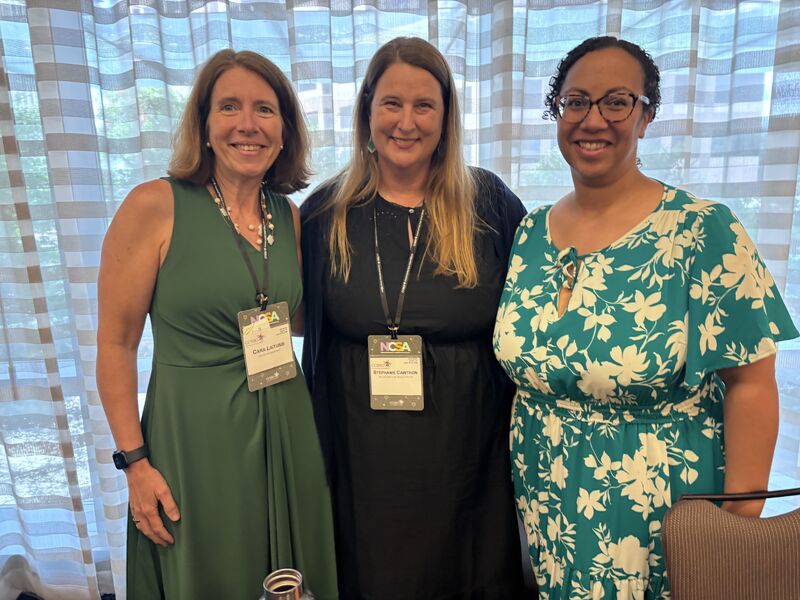
Three women in a pose in front of hotel conference room window, all smiling and wearing business conference dresses in a range of colors and patterns. Two are wearing conference badges that say NCSA 2026.
Reference
- Mayberry, R. I., del Giudice, A. A., & Lieberman, A. M. (2011). Reading achievement in relation to phonological coding and awareness in deaf readers: A meta-analysis. Journal of Deaf Studies and Deaf Education, 16 (2), 164-188.