

Summary
In the session, Beyond the Demo: Building an Evidence Base for Decisions about AI in Assessment Accessibility, Stephanie explores how responsible AI requires evidence, human expertise, and accessibility to guide informed decision-making in educational assessment.
At the CCSSO June 2026 Collaborative Meeting, I focused on a question that more organizations are beginning to ask: how do we evaluate AI responsibly before integrating it into accessibility?
The conversation was not about whether AI is good or bad.
It was about what evidence we need before AI becomes part of systems that directly affect students.
Looking Beyond the Technology
A key theme from the session was this: AI is not an accommodation.
AI is a production tool, a delivery option, or a content generator. AI can support accessibility work, but it cannot replace the principles that make accessibility effective.
We also explored an idea that continues to shape this research.
We grounded that conversation in the Smarter Balanced Student-Centric AI Design Principles, which emphasize fairness, transparency, security, explainability, agency, growth mindset, kindness, and helpfulness. Together, these principles provide a framework for evaluating AI not by what it can do, but by how responsibly it supports students and the people who serve them.
AI is probabilistic.
Accessibility is outlier-centered.
AI is designed to optimize toward patterns and averages. Accessibility exists because learners do not fit the average. That tension is not a flaw in either system. It is a design challenge that requires thoughtful decision-making.
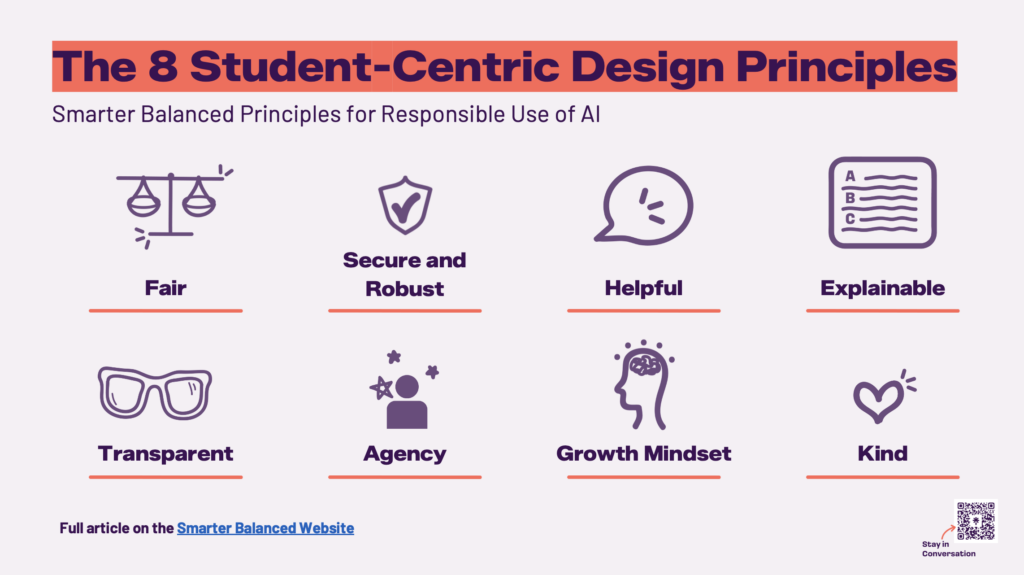
Infographic outlining the eight student-centric design principles for the responsible use of AI: Fair, Secure and Robust, Helpful, Explainable, Transparent, Agency, Growth Mindset, and Kind.
Asking Better Questions
Throughout the session, we examined emerging evidence across five accessibility domains, including American Sign Language, Braille, text-to-speech, embedded glossaries, and translated content. Rather than asking whether AI should be used, we explored where it may strengthen current workflows, where it introduces new risks, and what evidence states need before making policy decisions.
One distinction shaped every conversation.
Internal production is not the same as student-facing delivery.
Using AI to assist trained professionals during content development presents a very different set of questions than allowing AI to generate accessibility supports that students rely on during an assessment. That line changes the evidence required, the risks involved, and ultimately the decisions we make.
Building Systems Worth Trusting
What I appreciated most about this session was that participants moved beyond demonstrations of what AI can do and focused instead on what responsible implementation requires.
Capacity matters.
Potential harm matters.
The evidence matters.
As AI continues to evolve, accessibility cannot become an afterthought or a testing ground. It must remain grounded in research, human expertise, and the lived experiences of the students these systems are designed to support.
If your organization is navigating the intersection of AI, accessibility, and assessment, I would welcome the opportunity to continue the conversation.